Nolt Alternative: A Clearer Look at Nolt, Its Pricing, and nolby
Nolt costs $29 a month billed annually for one board, and has no free plan. What it does today, what each of its four price lists charges, and where nolby fits.
If you already use Nolt for customer feedback, the product probably doesn't need much introduction.
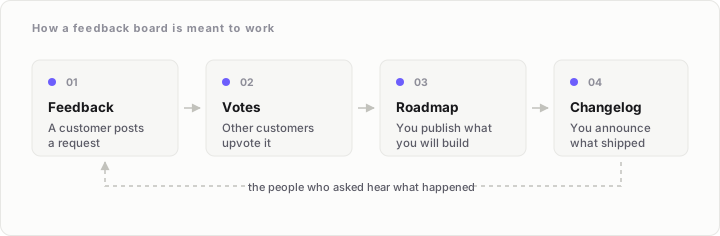
It's a feedback board built around a straightforward idea: give customers somewhere to submit requests, let other users upvote them, and use that feedback to inform what you build next. The board is clean, quick to set up, and covers the basics a small SaaS team needs.
But there is a point where a simple feedback board can stop fitting.
Maybe you need another board for a second product. Maybe you're looking for a free plan. Maybe the pricing has become harder to justify as your feedback operation grows. Or perhaps you're simply comparing what's available before making a decision.
That's where looking at a Nolt alternative makes sense.
One option worth considering is nolby. It takes a similar feedback-and-roadmap approach, but with a different pricing model and a deliberately smaller feature set.
Before getting into that, though, it's worth looking at what Nolt actually offers today.
What is Nolt good at?
Nolt is good at getting a feedback board up and running without much fuss.
The basic model is familiar: customers submit feedback, other users vote on it, and the team can organise those requests around a roadmap. Boards can also be embedded into a product, while a changelog is available for communicating completed work.
That simplicity is probably the biggest reason to use Nolt.
For a small B2B SaaS team, you don't necessarily need a huge product-management system. You need somewhere customers can tell you what they want, somewhere you can organise those requests, and a way to show people what you're working on.
Nolt does that.
It has more depth than the simple-board description suggests. The current feature set includes a changelog with a rich editor, categories, scheduled publishing, custom-domain hosting and an in-app widget. It can also draft changelog entries using AI, including from completed feedback posts or GitHub commits.
There are integrations with tools including Jira, Linear, monday.com, Asana, Intercom, Microsoft Teams, Discord, Trello, GitHub, Zapier, Pabbly and Make.
For larger organisations, Nolt also offers SAML 2.0, OpenID Connect and SCIM, as well as EU-hosted, data-isolated deployment.
None of that is a small product. If you are weighing Nolt against something else, weigh it against what it does now.
Where does Nolt stop fitting?
For a small SaaS founder or product manager, the question isn't necessarily whether Nolt has enough features.
It's whether you're paying for — or need — the features it has.
One of the more important things to understand is Nolt's board structure.
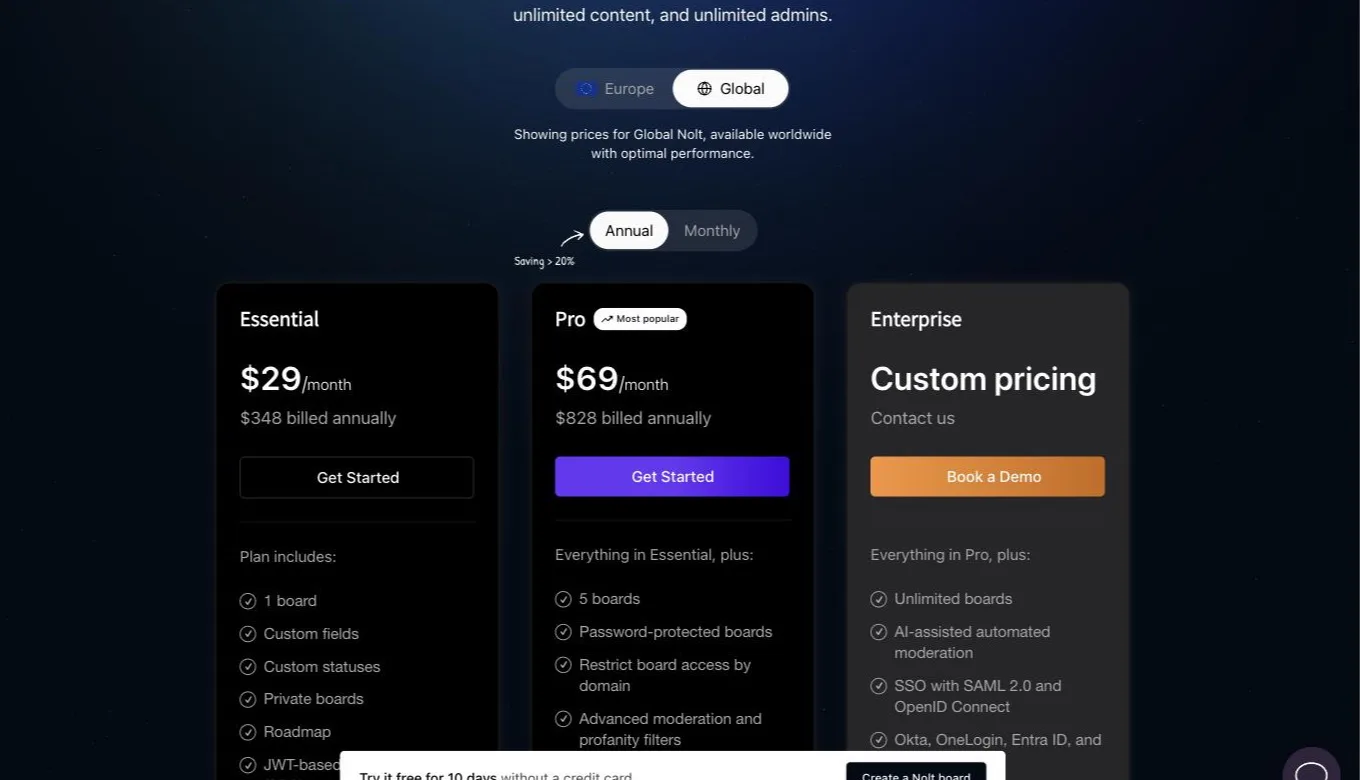
Essential includes one board. Pro includes five. Enterprise includes unlimited boards.
That can work perfectly well if you only have one product and one feedback board. But the moment you need a second board, you're moving from Essential to Pro.
On annual billing, that's a $40/month jump: from $29/month for Essential to $69/month for Pro.
And Nolt doesn't have a permanent free plan. There is a 10-day Pro trial for a new board, with no credit card required, but once that trial ends, the paid plans begin at Essential.
For a small SaaS, that's a fairly important distinction.
You may not need another dozen integrations or enterprise identity features. You might simply want another product board without having to move onto a higher pricing tier.
That's one reason to look at alternatives such as nolby.
Nolt pricing: the number depends on how you pay
Nolt's pricing is slightly less straightforward than the $29 headline figure.
There are four published price lists for the same three plans: Global annual, Global monthly, EU annual and EU monthly.
For Global hosting, Essential costs $29/month when billed annually, or $39/month when billed monthly. Pro costs $69/month annually, or $89/month monthly.
That means annual Essential costs $348 in total, while annual Pro costs $828.
The difference between annual and monthly billing isn't insignificant. Over a year, paying monthly costs an additional $120 on Essential and $240 on Pro.
For customers using EU-hosted Nolt, the prices are higher: Essential is €39/month when billed annually or €49/month monthly. Pro is €79/month annually or €99/month monthly.
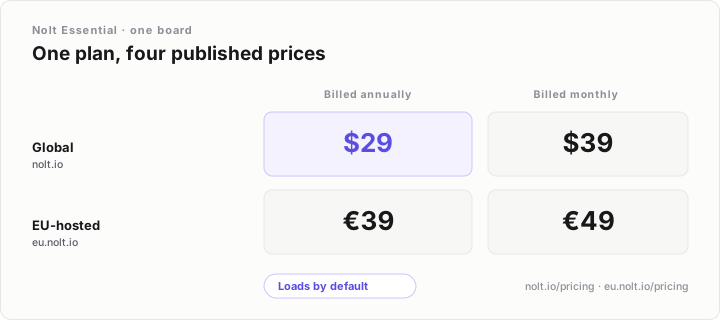
Here's the pricing at a glance:
| Plan | Boards | Annual billing | Monthly billing |
|---|---|---|---|
| Nolt Essential | 1 | $29/month | $39/month |
| Nolt Pro | 5 | $69/month | $89/month |
| Nolt Enterprise | Unlimited | Custom | Custom |
The important point isn't that Nolt's pricing is necessarily expensive.
It's that the pricing is tied to the plan and its board allowance. If one board is enough, Essential may be perfectly reasonable. If you need five boards, Pro gives you those five.
The question is whether that structure matches how your company actually works.
Nolt vs nolby
nolby takes a different approach.
Instead of charging based on how many boards you need within paid tiers, nolby has a free plan with one board, followed by a Pro plan with unlimited boards and unlimited teammates.
That makes the comparison particularly relevant for smaller SaaS companies.
nolby's Free plan costs $0 and includes one board, unlimited posts, votes, comments and voters, along with a public roadmap, changelog with email subscribers, and basic branding controls.
There is no per-seat, per-voter or per-tracked-user meter. Customers don't need an account to vote.
A board represents a product: it has its own roadmap, changelog, access setting and embed. Feedback categories can be used to sort different types of feedback within that board.
If you need more than one board, nolby Pro provides unlimited boards and unlimited teammates for $39/month, or $390/year when billed annually.
That annual price works out at $32.50/month and includes two months free.
A board is a product, with its own roadmap and changelog. Drag to set how many you run.
The second board is where the two models separate: Nolt steps up a plan, nolby does not. Rates from nolt.io/pricing and nolby.co/pricing.
There are trade-offs, though.
Nolt has considerably more integrations and enterprise functionality. It supports direct integrations with Jira, Linear, monday.com, Asana, Intercom, Microsoft Teams, Discord, Trello and GitHub, among others. It also offers SAML 2.0, OpenID Connect and SCIM.
nolby doesn't.
Its integrations at launch are Slack, plus signed webhooks that can reach Zapier, Make and n8n. There is no two-way Jira, Linear or GitHub sync, and there isn't a public API yet.
nolby's single sign-on is also much narrower. It uses a signed token to identify a customer's own logged-in users. There is no SAML, SCIM or directory sync.
So this isn't simply a case of one product being better than the other.
They're making different trade-offs.
| Feature | Nolt | nolby |
|---|---|---|
| Free plan | No | Yes |
| Boards on entry plan | 1 | 1 |
| Boards on higher plan | 5 on Pro | Unlimited on Pro |
| Unlimited teammates | Yes | Yes on Pro |
| Public roadmap | Yes | Yes |
| Changelog | Yes | Yes |
| In-app widget | Yes | Yes |
| Customer voting without an account | Yes | Yes |
| SAML 2.0 | Yes | No |
| OpenID Connect | Yes | No |
| SCIM | Yes | No |
| EU-hosted deployment | Yes | No |
| Direct Jira / Linear integrations | Yes | No |
| Slack | Yes | Yes |
| Zapier and Make | Yes, on Pro | Yes, via signed webhooks |
| Two-way status sync with issue trackers | Yes | No |
| Data export API | Yes, on Pro | Not yet |
| Custom roadmap statuses | Yes | Yes |
Most of that table is parity. The rows that decide anything are the first three and the enterprise block at the bottom, and the useful comparison is less about counting checkboxes than about which of those differences you will actually feel.
What does moving from Nolt to nolby involve?
Moving away from a feedback platform always has a cost.
There's the practical work of moving existing feedback, recreating your roadmap, changing embeds and making sure customers know where to go.
nolby aims to reduce that friction with one-click Canny import, but that isn't the same thing as a documented Nolt migration path.
So if you already have a large Nolt board, migration should be treated as part of the decision rather than an afterthought.
If you're starting a second product, however, the decision is simpler. You can create a new board rather than moving an established one.
And because nolby's Free plan includes one board, you can also try that setup without immediately committing to another subscription.
Is nolby the right Nolt alternative?
For a small SaaS, nolby makes the most sense when your priorities are straightforward.
You want a feedback board, roadmap and changelog. You want customers to be able to vote without creating another account. You may want multiple product boards as the company grows. And you don't want the number of people using your board to become another line on the bill.
In that situation, nolby's pricing is the biggest difference.
You can start with one board for $0. If you eventually need multiple boards, Pro provides unlimited boards and unlimited teammates for $39/month.
But there are good reasons not to switch.
If your team relies heavily on Nolt's direct integrations, needs SAML, OpenID Connect or SCIM, requires EU-hosted data isolation, or values its longer track record and published customer testimonials, Nolt has advantages that nolby doesn't currently match.
Nolt has been in the market for eight years and has named customers and published testimonials. nolby doesn't have those yet.
That's an important distinction for a buyer to consider.
The point of choosing an alternative isn't to pretend the incumbent has nothing going for it. It's to find the product whose compromises make the most sense for your company. We write one of these for every tool in the category, on the same terms.
For a one-to-fifty-person SaaS, that may simply mean choosing a feedback tool that doesn't make you pay more just because you need another board.
Nolt alternative: the short version
Nolt remains a capable option if you want a straightforward feedback board with a broader integration and enterprise feature set.
It has a changelog, an in-app widget, AI-assisted drafting and a wide integration list, and it keeps adding to them.
The main reason to look elsewhere is therefore not that Nolt is unusable.
It's that you may want a different pricing model.
nolby starts at $0 for one board and moves to $39/month for unlimited boards and teammates. In exchange, you give up some of the integrations and enterprise capabilities available from Nolt.
For a small SaaS that mainly needs feedback, voting, roadmapping and changelog communication, that may be a worthwhile trade.
For a company that needs deeper integrations and enterprise identity features, Nolt may still be the better choice.
How much does Nolt cost?
Nolt Essential costs $29/month when billed annually, or $39/month when billed monthly. Pro costs $69/month annually or $89/month monthly. Enterprise has custom pricing. EU-hosted pricing is €39/month for Essential annually and €79/month for Pro annually, with higher monthly prices.
Does Nolt have a free plan?
No. Nolt does not have a permanent free plan. New Nolt boards get a 10-day Pro trial without requiring a credit card. After the trial, you need a paid plan, with Essential being the entry-level option.
Does Nolt have a changelog?
Yes. Nolt has a built-in changelog, and its changelog feature is enabled by default on new Nolt boards. It includes a rich editor, categories, scheduled publishing, custom-domain hosting and an in-app widget. Nolt can also draft changelog entries using AI.
How many boards do you get with Nolt?
Nolt Essential includes one board. Nolt Pro includes five boards, while Enterprise includes unlimited boards. On annual billing, Essential costs $29/month and Pro costs $69/month, so moving from one board to the five-board Pro plan represents a $40/month increase.
Can I move my Nolt board somewhere else?
nolby has a one-click importer for Canny, not for Nolt, so moving a Nolt board is manual work today. Nolt publishes a data export API on its Pro plan and a spreadsheet export on every plan, so the data comes out cleanly — but plan the move rather than assuming it is automatic.
Is Nolt still being developed?
Yes. Recent additions include the changelog module, a GitHub commit integration and an MCP server. The MCP server is currently in beta. Nolt's own changelog page has no published entries, so the module is newer than the rest of the product.