Canny Pricing: How Much Does Canny Cost in 2026?
Canny charges by tracked user, so your bill rises as customers give feedback. This article explores how the model works and the flat-priced alternatives.
If you're looking for a customer feedback and roadmap tool, Canny is probably one of the first products you'll come across.
It's been around for years, has a polished product, and is widely used by SaaS companies to collect customer feedback, manage feature requests and publish roadmaps.
But there's one thing worth understanding before you sign up: Canny's pricing is based on tracked users.
That means your bill can increase as more of your customers start using your feedback portal.
For a small product with a handful of active customers, that may not matter much. But if you're building a product where hundreds or thousands of customers are expected to give feedback, vote on ideas and comment on requests, the pricing model becomes much more important.
So how does Canny pricing actually work, and what are the alternatives?
How does Canny pricing work?
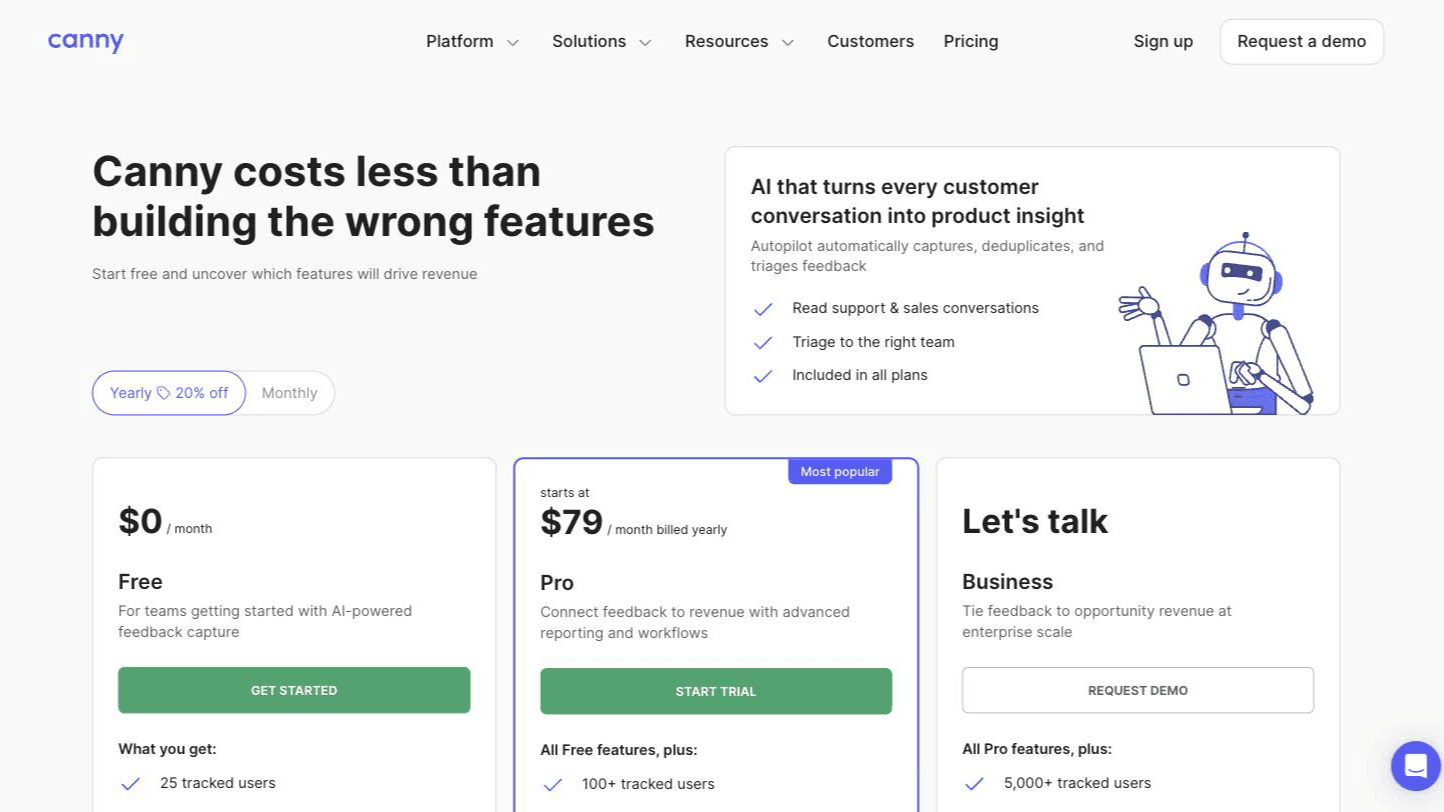
Canny currently has three plans:
- Free — up to 25 tracked users
- Pro — starting at $79/month when billed annually
- Business — custom pricing
The important part isn't really the number of plans, though. It's the definition of a tracked user.
Canny defines a tracked user as someone associated with feedback — for example, someone who posts, votes or comments. Users can also become tracked when feedback is submitted on their behalf or captured through Canny's Autopilot system.
Once someone becomes a tracked user, they count towards your limit.
That's a reasonable pricing model from Canny's perspective. If you're getting more value from the product because more customers are using it, the price increases with that usage.
But there's an interesting downside for SaaS companies.
The more successful your feedback system becomes, the more it can cost.
What is a tracked user?
This is the part of Canny pricing that's easy to overlook.
A "user" doesn't simply mean someone who has an account in your application.
A customer who submits a feature request can become a tracked user.
A customer who votes on an existing request can become a tracked user.
A customer who comments on a request can become a tracked user.
Canny can also create tracked users when your team adds feedback on their behalf or when its Autopilot feature captures feedback from other sources.
In other words, the people you most want to use your feedback system are the people who contribute to the number that determines your bill.
That creates a slightly unusual incentive.
You want more customers to participate.
Your pricing wants fewer customers to participate.
Canny pricing as your product grows
The difference becomes easier to see once you look at the numbers.
Canny's Pro pricing currently scales through different tracked-user limits. These are its published Pro prices as of 2026.
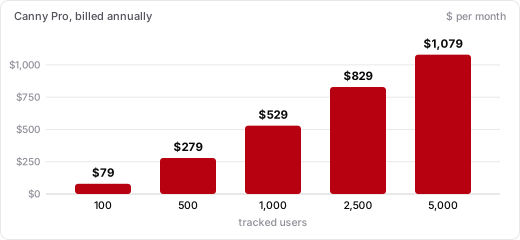
Anyone with a post, vote or comment attributed to them counts as one tracked user.
That works out at $0.75 per tracked user a month, billed monthly.
So a team with 100 tracked users and a team with 1,000 tracked users are using the same product, but they're paying very different amounts.
That's not necessarily a problem if the pricing model works for your business.
But it's worth asking a simple question:
Do you really want your customer feedback bill to grow because more customers are giving you feedback?
The problem with paying for customer participation
Imagine you've launched a SaaS product.
At first, you have 50 customers.
You create a feedback board and start collecting feature requests. A few customers vote on them. Others leave comments.
Then things start going well.
You reach 500 customers.
Then 1,000.
Your feedback board is now genuinely useful. Customers are actively telling you what they want, voting on priorities and helping you decide what to build next.
That's exactly the outcome you were hoping for.
But under a tracked-user pricing model, your feedback software has also become more expensive.
There's a subtle difference here compared with traditional SaaS pricing.
With most software, you're paying for the people on your team who use the product.
With Canny, you're also paying according to the number of customers participating in the feedback process.
For some companies, that's perfectly reasonable.
For others, it can make budgeting harder.
Simple to read, hard to predict
It's worth being fair to Canny here.
Their pricing model isn't inherently bad.
Usage-based pricing is common in SaaS. You pay more as you use more.
Canny also allows paid customers to set a monthly spending limit, which helps prevent an unexpected increase caused by more user participation.
The question is whether tracked users are the right thing to measure.
Your number of customers isn't necessarily something you can control.
You might launch a new feature and suddenly receive hundreds of votes.
You might put your feedback board somewhere more visible.
You might have a successful launch that brings a large number of new customers.
All of those things are good for your business.
But they can also increase the amount you pay for your feedback software.
A flat-priced alternative — Nolby
There is another way to price customer feedback software.
Instead of charging based on how many customers participate, you can charge based on the product itself.
That's the approach taken by Nolby.
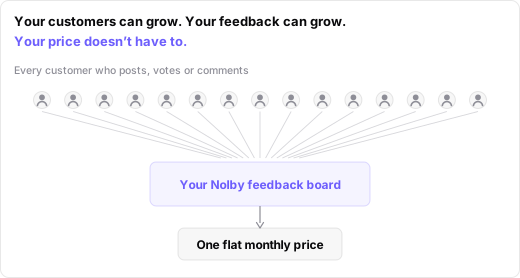
Nolby uses a flat pricing model rather than charging according to the number of customers submitting feedback.
You can have a small customer base or thousands of customers using your feedback portal without your bill changing simply because more people voted on a feature.
The idea is fairly simple:
Your customers should be able to use your feedback system as much as they want.
The two products are built around a similar basic job: collect customer feedback, understand what customers want, and use that information to decide what to build.
The difference is partly philosophical.
| Canny | Nolby | |
|---|---|---|
| Pricing model | Based on tracked users | Flat pricing |
| Customer participation | Affects pricing | Doesn't affect pricing |
| Pricing as you grow | Can increase with tracked users | Predictable |
| Feedback | Yes | Yes |
| Roadmaps | Yes | Yes |
| Product approach | Broad and configurable | Simpler and more focused |
Canny is the more established platform and offers a broad set of features and integrations.
Nolby takes a more focused approach.
The goal isn't to reproduce every feature Canny has. It's to provide the core feedback and roadmap workflow without adding unnecessary complexity — or making you pay more because more customers are participating.
So, is Canny worth the price?
For some teams, absolutely.
If you need Canny's particular integrations, workflows or enterprise features, the additional cost may make sense.
It's also a mature product with a long track record.
But you shouldn't look at the headline price alone.
If you're comparing Canny with other customer feedback tools, look at how the price changes as your customer base grows.
A tool that costs $79/month today does not stay at $79/month once hundreds or thousands of customers are posting, voting and commenting. The same is true of per-seat pricing, where the bill grows with the size of your own team instead.
That's particularly important for SaaS companies, because customer participation is the entire point of a feedback system.
When does a flat-priced alternative make sense?
A flat-priced feedback tool is particularly attractive if:
- You have a large customer base.
- You expect customer engagement to grow quickly.
- You want predictable monthly costs.
- You don't want to monitor tracked-user limits.
- You want customers to freely submit and vote on feedback.
- You don't need every advanced feature offered by a larger platform.
- You prefer a simpler product with less configuration.
For a small product with very few active customers, the difference may be negligible.
But as your feedback community grows, the pricing model starts to matter.
A simpler alternative to Canny
Nolby isn't trying to be Canny with a different logo.
It's a simpler customer feedback and roadmap tool built around the things most SaaS teams actually need:
Collect feedback → understand what customers want → decide what to build → publish the roadmap.
And because Nolby uses flat pricing, you don't have to worry about whether your next successful product launch is also going to increase your feedback software bill.
That's the main difference.
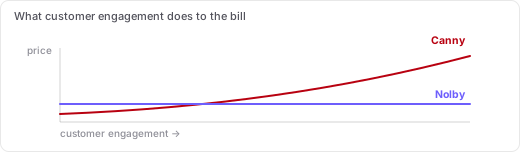
Canny's pricing grows with customer participation.
Nolby's doesn't.
If you want a straightforward feedback and roadmap tool without tracked-user pricing, Nolby is worth a look.